Emergency Medicine Physician Salaries: Does Where You Work Matter?
Matthew Behrens, MD
Across our dataset of 632 verified submissions, the national median sits at $265/hr, with the middle 80% of physicians falling between $210 and $335 per hour. The data is presented in 1099-equivalent dollars. In order to get closer to a "like to like" comparison, submitted W-2 rates are corrected upwards to compensate for FICA withholding and are exclusive of benefits. Check out W-2 vs 1099 in Emergency Medicine, for a better understanding of the relationship between 1099 and W-2 rates.
Submissions are grouped in bins spanning $20/hr. The dashed line represents the median.
| Hourly rate band | Submissions |
|---|---|
| ≤ $160 | 7 |
| $160–$180 | 8 |
| $180–$200 | 21 |
| $200–$220 | 54 |
| $220–$240 | 78 |
| $240–$260 | 103 |
| $260–$280 | 96 |
| $280–$300 | 67 |
| $300–$320 | 88 |
| $320–$340 | 48 |
| $340–$360 | 35 |
| $360–$380 | 14 |
| $380–$400 | 6 |
| $400–$420 | 4 |
| ≥ $420 | 3 |
Since I started collecting data on emergency medicine physician compensation, I've been struck by the enormous variance in salary. The difference between 10th percentile physicians and 90th percentile physicians is over $125/hr. That difference is jaw-dropping considering those two people are essentially doing the same type of work. Assuming the average EM physician is working 120 hours per month, that range represents a spread of $180,000 per year, greater than than the difference between the median emergency medicine salary and median salaries of most other medical specialties.[1] [2] What factors account for this variance and how do we end up on the right side of it? While the answer is undoubtedly multi-variable, let's start by breaking down the dataset by geography.
The South has the highest median hourly rate at $280/hr, compared to the Northeast with the lowest at $245/hr.
Bands span the 10th–90th percentile; the inner bar marks the 25th–75th; the tick is the median.
| Census region | 10th pct | 25th pct | Median | 75th pct | 90th pct | n |
|---|---|---|---|---|---|---|
| Northeast | $200 | $225 | $245 | $275 | $325 | 161 |
| Midwest | $210 | $230 | $275 | $305 | $340 | 103 |
| South | $230 | $250 | $280 | $310 | $350 | 226 |
| West | $200 | $230 | $270 | $300 | $345 | 141 |
The roughly $35/hr gap between the highest and lowest paying regions is often cited in emergency medicine compensation reports. However, this difference in median compensation is insufficient to explain the massive variance in EM salaries in general. In the figure above, I've modeled the data with p10–p90 ranges to show the variance in hourly rate. Notice that each region's p10 - p90 range mirrors the same national spread of $125/hr with significant overlap between regions. The variance within a region is 3.7x greater than the variance between them.
Metropolitan and rural areas sit at a median of $265/hr and $255/hr respectively, while micropolitan areas, described as areas between 10,000 and 50,000 people reach $300/hr.
Bands span the 10th–90th percentile; the inner bar marks the 25th–75th; the tick is the median.
| Urbanicity | 10th pct | 25th pct | Median | 75th pct | 90th pct | n |
|---|---|---|---|---|---|---|
| Metropolitan | $205 | $235 | $265 | $300 | $340 | 494 |
| Micropolitan | $250 | $265 | $300 | $315 | $325 | 76 |
| Rural | $190 | $220 | $255 | $300 | $325 | 56 |
I created this figure by cross-referencing submitted zip codes and their associated salaries with the USDA Rural-Urban Commuting Area, a tool the U.S. government uses to classify urban density. My initial assumption was that rural emergency medicine physicians would make a significantly higher average hourly rate than those working in metropolitan areas. Interestingly, this assumption breaks down when urban density is separated into three categories instead of two. Hospitals in micropolitan areas clearly outperform both their rural and metropolitan counterparts. The median rate is $35/hr higher and it noticeably decreases the variance, with a p10–p90 band that narrows from about $135/hr to $75/hr, a 44% decrease. Even better, the decrease in variance seems to come mostly from raising the bottom quartile of salaries. The micropolitan p10 is $45/hr higher than the p10 of metropolitan rates.
The finding is only hypothesis-generating, as the Moonlighter dataset doesn't explicitly describe why this occurs. My hypothesis is that splitting micropolitan and rural data separates two distinct entities, micropolitan hospitals that act as regional hubs with large catchment areas and rural critical access hospitals. Both suffer from a shortage of emergency medicine physician labor, but micropolitan patient volume remains comparable to urban or suburban centers. Micropolitan hospitals are forced to bid up wages to incentivize physicians, while critical access hospitals can offer comparatively lower wages due to lower patient volumes. In this scenario, critical access hospitals would still pay a premium, but on a per-patient basis rather than hourly. In both cases, a tight labor market gives EM physicians the leverage to retain a larger share of the value they generate relative to their metropolitan counterparts.
The NYC metro has a median rate of $225/hr, with the middle 80% of physicians earning between $195 and $250 per hour.
NYC compared against the pooled distribution of all metropolitan submissions nationally.
| Cohort | 10th pct | 25th pct | Median | 75th pct | 90th pct | n |
|---|---|---|---|---|---|---|
| New York-Newark-Jersey City, NY-NJ-PA | $195 | $205 | $225 | $240 | $250 | 61 |
| All U.S. metros | $205 | $235 | $265 | $300 | $340 | 494 |
In the figure above, I compare submissions within the NYC metro area to all metropolitan submissions. Predictably, NYC fares worse than the rest of the country, with a median rate that is $40/hr lower than the national metro average. NYC has several unique factors that drive rates down beyond other metro areas, but I'll save those for another post.
Within the dataset, NYC represents the highest density of submissions within a single geographic statistical area. That also makes it the best candidate for showing how an individual job market compares to national statistics. My reason for including it in a conversation about national trends is to compare the variance of a single job market to the national figures often cited. The p10 – p90 is about $55/hr, representing only 41% of the spread that exists across the aggregate of all national metro submissions. Narrowing the geographic focus substantially decreases the noise in the dataset.
The job market for emergency medicine physicians is local. Dividing the data into large geographic subsets like regions or urban density can reveal interesting patterns, but it doesn't answer the question physicians care about most: is this a fair rate?
We intuitively understand that pooling rural central Pennsylvania, Rochester, and NYC into the same aggregate for housing prices would make little sense, yet many emergency medicine salary surveys do exactly that. When you buy a house, you check what the neighbor's house sold for. Likewise, when you find a job, the first step is to ask what the physicians across the street make.
The 632 submissions used for the figures in this post are NPI-verified, self-selected submissions, not a random sample of EM physician salaries and subject to the biases therein.
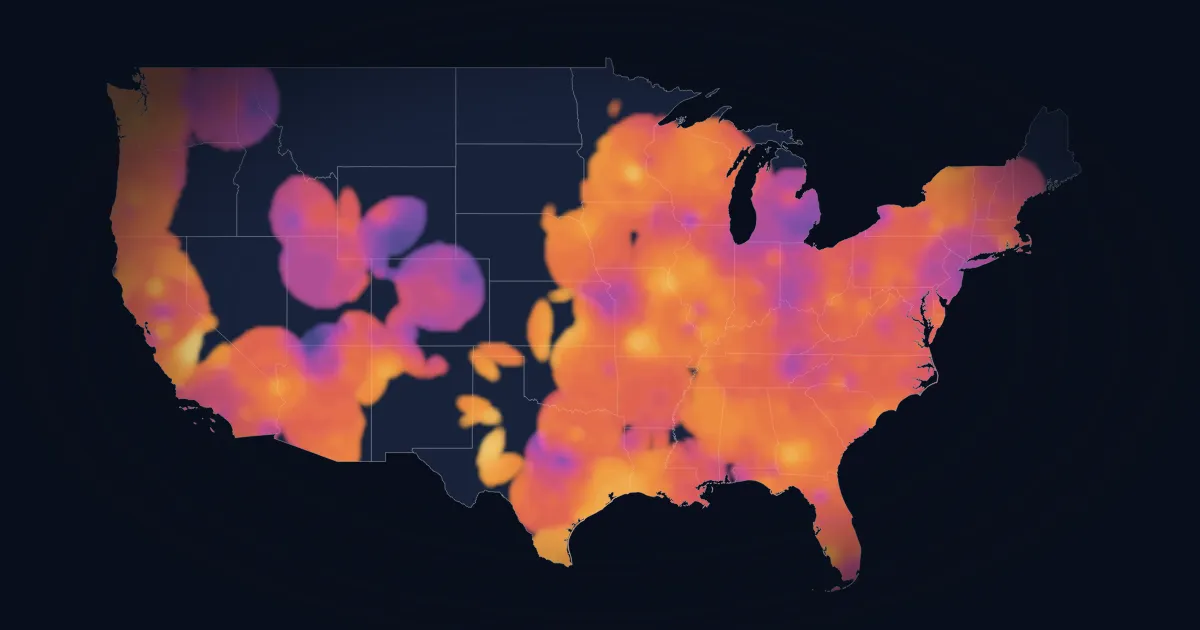
Moonlighter is a physician-built community platform that lets EM physicians share salaries anonymously. If you're an emergency medicine physician and would like to see the data for yourself, consider creating an account to view the map.